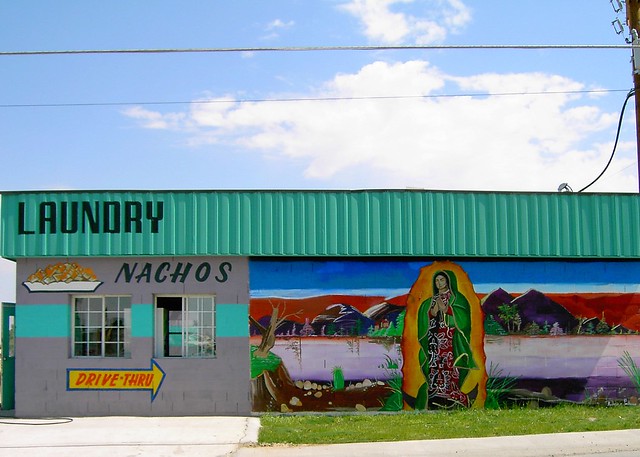
Several weeks ago, (or, as the silly always say, way back last year) Jim Tolbert posted a lovely photo of the Elm Street Guadalupe on his blog. And as I am in the business of seeking and photographing all things OL Guadalupe here in the land of the lost, the Judge and I went to locate this Guadalupe so that I too could photograph it. We wound our way around the central El Paso neighborhood until we discovered this gem. I particularly love how the artist used metallic paint for her aura/hallowedness and that the wrought-iron fencing is painted to match her and the background.
Now, I will be the first to admit that I am not the best at writing on a daily/weekly basis. In fact, after I publish I continue to edit my blog entries. However, I can explain what I have been ruminating about recently, which is about how several iconic mural/graffiti images in El Paso were destroyed in 2008, which happens to adjoin what Jim has been blogging about lately (tagging.)
Now, I am a fence sitter on the subject of tagging/graffiti/street/urban art. But I have read enough by sociologists, urban archeologists, and rhetoricians to know that blanket statements such as, "all taggers are gang members" (of a more troubling criminal kind) is incorrect and too black and white. And while I do not like seeing slap dashed tags scrawled by "gangs" of ego-centric energetic "kids," I will say that this is something that happens in urban environments. It also happens in small towns, covered bridges in Madison County, and hidden caves in France. Nor, is this activity specifically an ethnic, gender, or age thing. Suffice it to say, graffiti is an act of writing, an act of opportunity, an act of rebellion, and above all, an act of communication.
Tags, just as billboards, have an audience, with their messages arranged in a particular way for a particular reason. They exist to persuade (mostly anti-establishment, anti-status quo.) Its delivery method, while silent, screams, "Listen to me! I exist! I have purpose and I am here." This is not really so different from the Elm Street Guadalupe, except of course, that a tag is written without permission. Tags are a form of unsanctioned speech where permission to exist was not first given. And as a tangential audience to these speech acts, we may not believe, and we may not approve. We may become angry that a wall supports scrawled utterances. Nevertheless, one or many people exist behind such statements on silent rock and plastered walls. Are we ready to listen to what they have to say?
Selected bibliography on the Visual Rhetoric and Rhetoric of Graffiti
Barack Obama is a work of art [Television broadcast]. (2008, November 5).
Denver: Columbia Broadcast System. Retrieved December 5, 2008, from
http://www.cbsnews.com/video/watch/?id=4385596n%3f
Bearman, J. (2008, October). Street cred. Modern Painters, 20(9), 68-73.
Benjamin, Walter. "The Work of Art in the Age of Mechanical Reproduction."
Marxists.org. Feb. 2005. 25 June 2007.
Chia, Adeline. "Spray paint art." The Straits Times [Singapore] 21 June 2007. 12
July 2007.
"Critical Mass." Visual Resistance. Visual Resistance. 25 Apr. 2007.
Currid, E. (2007). The Warhol economy: How fashion art & music drive New York
City. Princeton: Princeton University Press.
D'Amico, Daniel J., and Walter Block. "A Legal and Economic Analysis of
Graffiti." Austrian Student Scholar’s Conference. Grove City College, Grove
City, PA. 5 Nov. 2004. Art Crimes. 11 Apr. 2007.
D'Angelo, Frank J. "Sacred Cows Make Great Hamburgers: The Rhetoric of
Graffiti." College Composition and Communication 25.2 (May 1974): 173-180.
"Ghost Bikes." Visual Resistance. Visual Resistance. 22 Apr. 2007.
Hermer, Joe, and Alan Hunt. "Official Graffiti of the Everyday." Law & Society
Review 30.3 (1996): 455-480.
Drapes, Carolyn Rhea. "The City :: Urban art, stickers, stencils, murals, and
painted building texts." Flickr. 26 Apr. 2007. 26 Apr. 2007.
MacGillivray, L., & Curwen, M. S. (2007, February). Tagging as a social literacy
practice. Journal of Adolescent & Adult Literacy, 50(5), 354-69.
Lachmann, Richard. "Graffiti as Career and Ideology." The American Journal of
Sociology 94.2 (Sept. 1988): 229-250.
McLuhan, M., & Fiore, Q. (1967). The medium is the massage. New York: Bantam.
Montoya, Isaiah. "Graf in Hush Tones." The Border Observer [El Paso] 6 Apr.
2007, sec. American Sprit—Fine Arts: 26-27.
Rafferty, Pat. "Discourse on Difference: Street Art/Graffiti Youth." Visual
Anthropology Review 7.2 (Fall 1991): 77-84.
Schlecht, Neil E. "Resistance and appropriation in Brazil." Studies in Latin
American Popular Culture 14 (1995): 37-68.
Shannon, Joshua A. "Claes Oldenburg's The Street and Urban Renewal in Greenwich
Village." Art Bulletin 86.1 (Mar. 2004): 136-161.
Walker, William. "The Lessons of Guernica." Toronto Star [Toronto] 9 Feb. 2003,
sec. Business: B01.