Tuesday, September 02, 2014

Teletype, Scotch® tape, X-ACTO® knives, and laser paper: Adventures in old school news clipping services for corporate decision makers

Note: this was originally began and then saved from 2013.

On October 4, 2013, NewspaperTree reported results of an inquiry to the Texas Legislative Reference Library (LRL) on how it selected articles for its Daily Legislative Clipping Service (DLCS) news briefing and if it had documented its selection process. What impact does the DLCS have on El Paso/Juarez region (including Fort Bliss) news and information state elected officials? Sounds simple, right? It should have been, yet the Tree encountered umbrage, drama, and delaying tactics after its initial questions were rebuffed, which then led to an open records request, which led to bargaining by the LRL. With all that you'd think they didn't want people to know that the DLCS,
  1. Exists at all.
  2. Holds no written documentation about its selection process or its policies and procedures.
  3. Overlooks or unconsciously ignores borderland (and its constituents') stories, articles and issues.
  4. Receives undo influence outside the LRL to select only news affecting a small group of large cities and/or topics that will only affect specific people, interests, and groups. 
Common sense dictates that we should understand how DLCS chooses its news articles. Yet, judging from the blowback received and information finally obtained, one has to wonder why the Tree encountered such obstruction and digital drama from the good people at LRL. In their article, "Out of sight, out of mind: Capitol news clips keep El Paso stories below the fold" the online weekly notes that,
On August 13, 2013, Newspaper Tree submitted an open records request to the library seeking any documents reflecting its policies on their clipping service. (Legislative Reference Library director, Mary) Camp responded to the request by phone, saying she would only talk on the record if Newspaper Tree withdrew its open records request. 
Newspaper Tree declined to withdraw its request.

Under the Texas Public Information Act, responses to requests must be made within 10 business days. Ten days following Newspaper Tree’s request, Camp responded by mail with a $51.80 invoice for the requested materials. Her letter arrived on September 3.

The LRL refused to provide an invoice via email to expedite the payment process.

The responsive documents were mailed to Newspaper Tree on September 9 and arrived September 11—nearly a month following the initial request.
NewspaperTree rightly investigated how DLCS articles are being selected and distributed to politicos in Austin and beyond. As the Tree is part of the fourth estate too, it has a right to know why or why not their stories are selected for the daily briefing.

However, it is safe to assume (not really, but follow me here for a bit), that many people, including elected officials and their staffs could simply Google "El Paso," "Juarez," or "West Texas." But, the kicker is that officials (or aids/interns) must first chose to query El Paso/Juarez borderland news and information.

The delaying tactics and reaction to that simple question makes me wonder if the staff fears for their future. Yet, no small an audience can offset its practical, political, and potentially influential effect upon those who could receive the DLCS. On the other hand, Bob Moore, editor for The El Paso Times believes, as do I, that such a service may have already begun its endgame, when he noted that, "The whole notion of a clipping service in a social media world is really antiquated. It’s just not how human beings share information anymore.”

Yet, if certain parties or influential groups are not truly interested in reading about what's going on here, then how likely are they to be persuaded to ask about and understand our issues? Not very, if history serves. What if they could receive something regularly that provides them with news and information about our region? Because if a team of news sniffers and clippers exists, at least for now, the chances are very good that our issues will be acknowledged and read. That is why we should demand that they explain how their selection process works and is implemented. Once received, what were those results and what does it mean for us?

The "back in the day" moment

This made me recall how a small team of women used to prepare and publish a daily new briefing for the mostly male executives at the company formerly known as El Paso Natural Gas Company (EPNG), El Paso Energy (EPEnergy), and in its end days, El Paso LLC (El Paso). Hm. Seems that the closer you get to one's total corporeality elimination fewer keystrokes make up your moniker. But that's a story for another day. Concerning the corporate method of informing decision makers, here is my take on news clipping process and procedure. While we selected from any and all sources of information daily available, I see little bias or politics in how the articles were chosen. If there was any it was slight because our time to gather, cull, index, assemble, print, and deliver was so short. There was simply no time, unless that bias was unconsciously made, which is possible in any case when quick decisions are made.

Daily Newsbriefs

From about 1994 until around 2000, Lee Byrd daily edited and indexed, while I sourced and laid-out (cut and paste from hard copies) the daily Newsbriefs clipping service for the executives at EPNG/EP Energy. Previously, a long-time analyst edited the daily briefing until she retired. Goodness only knows how many years she worked her publishing magic as she compiled the stories herself, indexed, and published with the help of a paraprofessional. After Lee and I departed the company, the clipping service continued, and evolved into a digital service developed by their in-house IT personnel and used until the company was sold to Kidder-Morgan, Inc. (KMI) in 2012.

I must say that my stint as a "clipper" was truly fun and fast-paced as we worked every morning to provide the original from which copies of the executive news report had to be to the EPNG copy center in the basement of the Blue Flame Building no later than 11:15-11:30 each day. The report usually ran approximately 20-35 pages and contained energy industry and general news and stock information (double sided, not reduced in size) each day, depending on how the news went that previous evening until around 9:30-10 am the day it was distributed.

Our daily default sources included Oil and Gas Daily, energy sector stock prices, which for its time included Tenneco, SoCal, PG&E, and the dread company Enron. Due to its specific audience, we rarely included op-ed pieces unless written by someone in the company with a specific persuasive bent. Sections within the briefs included (transmission) rates, public policy, and environmental/science, petroleum/gas engineering and transport articles as well as the occasional think piece covering exploration, the environment, and world energy/political stories from US News & World Report, The Economist, the pink Financial Times, The Los Angeles Times, and San Francisco Chronicle. Interestingly, we usually did not select stories from Mexican papers, such as El Diario de Ciudad Juárez or other regional papers outside papers in Farmington or the Permian Basin unless a breaking story warranted its selection. In addition, the NewsBriefs was faxed to company executives in its San Francisco, Farmington, Midland, and Houston offices. With that many dispatched pages to so many readers, we committed arborcide weekly.

Lee decided the order and which stories, while I pitched non-industry and trendy-type stories that could be of tangential interest to the audience, which was from the President to the director level. The idea was to have the copies distributed during the noon hour so that the (mainly male) recipients had the report on their desks by 1:00 (after lunch). If someone was flying out on one of the Gulfstream jets (as when Bill Wise, another Executive VP, or perhaps a Director/VP combo, we made an effort to publish earlier. This was at a time when the Teletype machine was giving way to Internet published articles. When I worked with the long-time editor before Lee, she had the stories compiled and indexed and I did the paste-up. When Lee and I worked together, I was compiling stories at home late at night just when the NY Times, Washington Post, Houston Chronicle and The El Paso Times were beginning to publish their editions online. I cut and pasted the texts and then emailed the stories to the office. Overall, we had no guidelines, just stuck to industry related stories that affected their work in the Gas Transmission industry. Later I heard that electronic versions were made available, but interestingly, many executives preferred the hard copies, as they were the most portable and sharable with their managers and administrators. Like cash, the Newsbriefs circulated and recirculated within the offices.

Thursday, August 28, 2014

Long time, no see

One of the problems with experimenting and writing for social media (from blogs, to microblogs, to inbetweeners like Tumblr) occurs when projects go dark. In the case of my photoblog, this has happened to the extent that I've not posted anything here for a while. That's not to say that I've not wanted to add to the site, but that I have not had the chance to create a new post.

A lot has happened since my last post (which perhaps I'll detail sometime in a blog page here), but here I am on the other side, and wanting to write again. To help with this, I have a new project that I hope can work with this site.

For at least this semester, I want to experiment with the form by adding additional pages to see how such offshoot pages affect navigation and how they function when posting related topics and images off the main blog page. The impetus for this project is so I can show my students how Blogger could work with their e-portfolio project.

I don't know if it will be fully successful, but it is worth a try. Instead of publishing a student paper, I'll post drawings, photographs, short non-fiction essays, and poems.

In this way, I can see if additional pages will work within the framework of the Blogger blog format. For today, and because this is a photoblog, I offer this recent image taken in my backyard. I believe it is a sapsucker and s/he hung out at the feeder all day long last November.

Wednesday, November 14, 2012

Another one will bite the dust, but not by fire


Sadly, it will take a few of these to disappear and become a blot on downtown and elsewhere in town before people finally become aware of just who and for whom council serves...because it sure doesn't serve historic buildings that's for sure. Note the following blog entry, on the El Paso Development News site. Dated in October after the Historic Landmark Commission (HLC) denied approval for the demolition of the Trost building, the entry provides a good backgrounder on the location of the now fated Muir building (ironic in what the name of another John Muir evokes) and images of its original façade and what it looks like today.


According to the entry on the El Paso Development News site:
The application for demolition was submitted by the Borderplex Community Trust, a Real Estate Investment Trust (REIT) originally created to facilitate the City's original Downtown 2015 Plan which was announced in 2006. Since then, the REIT has focused on purchasing properties, such as the Wells Fargo and Chase buildings downtown, but has made few moves in terms of revitalization. If approved by the City Council, this would be the first major construction project put forward by Borderplex in El Paso's downtown.
However, today we know the result. And, given the history in this town of developer influence (and their cronies on council, ad nauseum), of REITs, Razing, and Resurfacing for flat parking lots, be on the look out for just that on this space soon. Now be sure to thank the Borderplex Community Trust, et al. for this bright spot on the horizon. 

Sunday, July 22, 2012

Then and now: Zanis Travels Again to Colorado Bearing Crosses

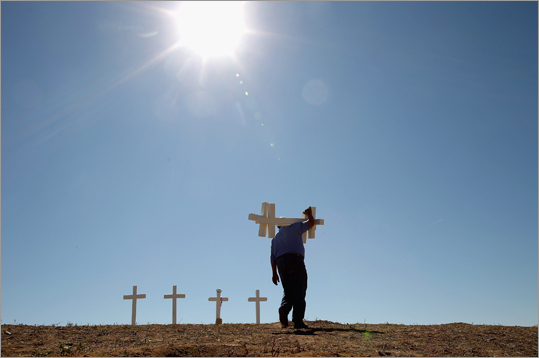
As near to the site of death(s) as possible, descanso creation and installation will erupt within an hour or so of any sudden tragedy--especially when the dead are young. Especially when the tragedy was senseless. What happened on July 20, 2012 in Aurora, Colorado in terms of the amounts of public mourning and outcry was no exception. Here, the Boston Globe (boston.com) documents the labor of love created by Greg Zanis of Aurora. This was the second time that Mr. Zanis traveled to Colorado to place crosses for the dead.
Greg Zanis of Aurora, Ill., carried two of the 12 crosses he made for a makeshift memorial to the victims of the mass shooting at the Century 16 movie theater in Aurora, Colo. A carpenter by trade, Zanis made the 12 white crosses that were placed near Columbine High School after a mass shooting there in 1999. Zanis said he made these crosses as fast as possible and drove all night across the country to place them across the street from the theater.
Chip Somodevilla/Getty Images

Greg Zanis, of Aurora, Ill., writes a name on one of 12 crosses, one for each victim, across the street from the Century 16 movie theater in Aurora, Colo.
From a file photograph. Zanis constructed the crosses near Columbine High School in Littleton, Colorado. In 1999, the St. Anthony Messenger credited Zanis with creating a touchstone upon which mourners could focus their grief.
This April 28, 1999 file photo shows an unidentified woman with 15 crosses posted on a hill above Columbine High School in Littleton, Colo. on April 28, 1999 in remembrance of the 15 people who died during a school shooting on April 20.

While such events probably won't cease, some solace arrives and places of contemplation are created because of the selfless work of people like Greg Zanis. 

Friday, July 13, 2012

old las vegas highway near old pecos trail

Last weekend, we drove to Santa Fe by way of Highway 54N. We entered Santa Fe from the south along the old Route 66, the Old Las Vegas Highway. It was a beautiful and rainy cool weekend, which was fun to have experienced.

We approached Santa Fe after 4 p.m. Saturday afternoon. Ever on the lookout for descansos (roadside memorials spontaneously built by the bereaved), MJ spotted beautifully painted crosses and a star of David on the right-hand side of Old Las Vegas Highway. About this point, we were quickly approaching  the Bobcat Cafe on Old Pecos Trail.

Originally, the first image posted was meant to capture the geo-locator code near the descanso site; however, I have been unable to find retrieve the code. I did however, capture several images of the arrangement, which like so many in New Mexico and across the country are situated along narrow, two-lane roads. Many appear on either the I25 median between its north and south-bound traffic between Albuquerque and Soccoro, or along the southern end of Highway 54 between Northeast El Paso, Texas and Alamogordo, New Mexico. The latter has many poignantly elaborate and permanent memorials.

Whenever I get out of the car to photograph these installations, I'm never scared of the traffic. Then again, I don't stand in the middle of the road to take my images even though I would like to do so.

Descanso on the Old Las Vegas Highway commemorate the location where
lives of four friends were cut short one night in June 2009.
Returning to El Paso on Sunday, I traced the names of those killed and connected this memorial with another descanso arrangement I photographed in February 2010. According to the Santa Fe New Mexican articles, the horrific accident killed four teens and critically injured a fifth. Santa Fe New Mexican articles published on June 28 and July 1, 2009 described the site's accident. In addition to this descanso, another was constructed when memorial sersvices were held near Santa Fe Prep and Cathedral Park. At the present time (7/7/2012), the June 28 article still presents the Cathedral Park memorial service slide show.

The newspaper details how the oncoming driver (who was under the influence with a blood alcohol level twice the legal limit, and drug paraphernalia in his vehicle), was tried for the critical injury and the four deaths. However, after many delays and various theories as to what happened that night, the jury found him nonguilty on all counts. Because he was originally charged with the deaths and grievous injury only, he was not even found guilty of the DUI and possession of the drug paraphernalia and alcohol found in his vehicle.

Santa Fe Descanso :: February 2010
Quite frankly, it was a shocking resolution to such a senseless tragedy. Evidently, theories were allowed entry that convinced the jury the driver, though clearly breaking DUI laws, was not responsible for the deaths, and let him off scott free.

However, in some kind of cosmic karmic realignment, the man was arrested for another DUI this past March. Perhaps he will get the help he needs, and have his license forever revoked.

While I must admit that descansos have fascinated me since grade school, it is in researching the tragedies that help me connect with those who loved the missing and pause to think on how quickly our lives can change because of the actions of another. My interest in such beautiful and material essences of love for friends and family was seared into my psyche when two sisters were killed in a bridge underpass near Crockett Grade School in the mid-1960s.

Back in the day, such information was communicated only by radio and one friend calling another. The day of that accident, there was a lot of confusion as to where my cousins were and my aunt was frantically awaiting their arrival--she had already heard of the accident happening near their home. Although terribly worried and saddened about the accident, she deep down knew that my cousins would not have been under that bridge at that time--it was in the opposite direction of their home. Yet as with many other occurrences and frights, you just never know what is happening until all is revealed later. My cousins eventually returned home safe. But because I knew about the accident, had listened to my mother describe the phone call she had with my aunt during her tearful vigil, I immediately understood the reason for the crosses, the flowers, the teddy bears, the valentines left beneath the railroad bridge--a daylight drunk driver had killed two little girls who walked home from school one afternoon--results that were the same then as now.

Please, don't drink and drive, don't text and drive, don't drive under the influence.

Parking lot discipline redux


This is a revised version of this previous post.

Parking lot discipline

U.S. Parking lot pay box on San Antonio Street, El Paso TX
Discipline and Punish and the U.S. Parking
pay box (Source: crdrapes, Flickr.com)
 
Texas license-plated cars displaying expired state inspection stickers will receive a ticket from police officers. Such law enforcement officials stake out places where they believe they can readily see, detain, and punish. They do this by issuing a ticket for infractions of the law. As a result, the driver goes to court to prove their car can display a valid sticker. However, the court does not see the car, but only a receipt for the sticker; this method of substitution shows that the car passed the state inspection; it is in a state of being mechanically and environmentally safe. 

If the vehicle owner needs to reschedule their court date, a form obtained from an attorney, will defer the court appearance and allow the driver to receive another court date. In order to reschedule, however, the driver must go first, with form in hand, to the Municipal Courts building on Overland Street. There, they pay the clerk 10¢ for a stamped-dated copy (she’ll give you a receipt for the money), and will file your request to reschedule accordingly.

After first arriving in front of the building, however, a driver must park their car. A lack of free or metered parking on the street in front of the building results from the many reserved spaces marked for police and consulate cars (note that the Mexican Consulate is around the corner on the not so ironically named San Antonio Street.) Therefore, if a member of the public has business to conduct in the courts building, a driver must park their car inside the U.S. Parking lot across the street.  It was inside this space that I first noticed the punitive connection between  said ticketed vehicles, the vehicle owners, the government, the enclosed parking lot space, the company owning the lot, and the transparent outcome as defined by Foucault.

In Discipline and Punish, Michel Foucault argued that spaces, particularly those created by the state, use various rhetorical devices such as work orders, building codes, permits, inspections, and even parking tickets. Together, they form areas of “enclosure” common to all, which Foucault explained is “a “protected place of disciplinary monotony” (pg. 141). Such monotony encloses places that will transparently discipline and punish, which serve to control public behavior. While such spaces change and shift over time and location, those controlled include all who utilize the parking lot, whether vehicle owner, attorney, or consulate worker. 

In this public space on San Antonio Street, the state coordinates with a corporation to publicly corral those entering the lot; it calls attention to all, no matter guilt (ticketed driver) or innocence, such as a consulate worker, lawyer, or someone requesting any copy of a government document.

While a community designs their towns by applying codes, permits, and laws, over time, such collections of rhetorical formations, whether paper, asphalt, paint, or brick create enclosures. Generally, the public never sees or feels enclosure because such accumulated visual statements present a normal, familiar, and therefore, neutrally silent space. Over time, layers within larger spaces, such as buildings, streets, and sidewalks are torn down, and reconstructed as required for safety and redevelopment. This results in widened street lanes, sidewalks disappearing or appearing with new ramps installed for those with special needs (ADA compliance), or even side streets disappearing altogether to enlarge nearby buildings (such as seen in developments recently built by First Baptist Church on Montana Street). By decree, many street level details will change (and those systems residing underground, too, such as drainage pipes and cable lines). Each change results in outcomes never planned originally. In this somewhat painless yet effective (re)formation, changes have the potential to punish and discipline due to the order and powers ordering the changes. On the other hand, pre-determined and publicly approved designs and spaces such as prisons and schools control behaviors overtly.  In terms of the San Antonio Street parking lot, I located an enclosed space that shocked and enlightened when I briefly applied Foucault’s notion of distributing individuals where I, and others stood.

Street side

U.S. Parking lot pay box on San Antonio Street (detail), El Paso TX
U. S. Parking pay box detail (Source: crdrapes, Flicker.com)
U.S. Parking constructs simple facilities, and at this location present a simple asphalt-covered ground with yellow or white diagonal painted lines and numbers that denote spaces to rent for short-term vehicle parking. A simple metal box pained red, soldered to a pole stands at the parking lot entrance. Atop the box a flat trapezoidal-shaped metal sign explains the terms for parking, the cost, who to call in case the vehicle violates the terms and gets towed, and the length of time for which you paid (four dollars). Painted in patriotic red, white, and blue upon a white field, the first line in the largest, upper case text shouts, “PAY HERE / (IN ADVANCE).” Blue text explains the fee and hours, and a red band with white text instructs the driver to “park in numbered space / pay corresponding number on meter (the box). The box accepts coins and bills; according to a pink paper taped to the sign, you may not pay with a check. At this location, U. S. Parking exchanges money for the privilege of parking from 0—12 hours. On a slow day, this means I paid for about 15 minutes of space rental time.

Based on the configuration of a space within a space, the parking lot conforms to Foucault’s definition of partitioning, a “disciplinary space tends to be divided into as many sections as there are bodies or elements to be distributed” (pg. 143). Within partitioning lies the discipline, although Foucault further explains that such spaces are free-floating and having no order; this means that the spaces and the lot are both elements of the same larger space. For Foucault, the more important idea here is to know that it is the hierarchy that determines the power exerted over the vehicles, drivers, and spaces, while the city (and the parking lot company) ranks higher than the renters, walkers, and workers. However, the parking lot ritual becomes further Byzantine due to the method by which renters pay their fee. It is not merely the amount you must pay, but how you pay the rent. 

To pay for a parking space, a driver puts money into the box by cramming the bills into the corresponding slot, which is a narrow slit in the red metal box attached to a pole. This is further complicated by a small pink piece of paper taped to the sign that reads, “cash, no checks please.” Therefore, it is not just the price of the parking lot space ($4 for 15 minutes in my case), because this is America. Instead, it was the way a person must “feed,” stuff, or cram the money into the red box.

While the rent is four dollars, I believe the company hopes you will pay the rent using a $5 bill because you were late, rushed, or did not have the exact change. The box has extremely narrow slots, which works together, along with the location of the lot and its spaces. The manner of how to pay the money and why you must pay illustrates how the location can punish and discipline a second time. The box disciplines by making you cram the money into the red box, which you would not have had to do if you had had your car inspected on time, if you had taken the bus and walked to the building, if you had someone drop you off, or if you had taken a cab. The slot punishes because you must stand and roll your dollar bills so tight. For me, the action of rolling made me think about my grandfather who rolled his own cigarettes with Bugler Tobacco. It punished me because it made me remember that I still miss him even though he died many years ago. It punishes because I must stand in line with others, who will watch my money rolling procedure. It punishes others because I watched them, as well—in fact, I took their picture for this essay. Further, before I left the lot I had to make sure the money dropped to the bottom of the box. So I had to cram the bills into the box with a metal shiv attached by a chain to the red U.S. Parking box. This then reminded me of all those television police procedurals with detectives inspecting dead bodies of prisoners killed with prison-made shivs.

Geography disciplines and punishes through place, the parking spaces, the other renters, the corporation, and the box that stands across from the courts that represent the state—the place where no one can park on the street. In the end, the hierarchy of space, place, and occasion add up to what Foucault describes as “the space of … perpetual movement in which individuals replace one another in a space marked off by aligned intervals” (147). In the end, our “docile bodies” engage with the cycle, which began with a specific time and place because of my expired inspection sticker, and the police officer that issued the ticket, which later resulted in my having to reschedule my court appearance (for which I did attend). The sticker, the ticket, the court date, the dollar bills, the sign, the narrow slots, the metal shive, the street, the courts, and the red box all align to discipline and punish those wanting the privilege of driving and relocating bodies within spaces created by and for a hierarchy of power.

Reference: Foucault, M. (1995). Docile bodies. In A. Sheridan (Trans.), Discipline and punish: The birth of the prison (2nd ed., pp. 135-169). New York, NY: Vintage. (Original work published 1975)

This essay was originally published by Drapes, C. R. (2009, December 19). Discipline and punish and the US Parking slotted pay box [Web log post]. Retrieved from el paso daily photo blog: http://www.chacal.us/2009/12/discipline-and-punish-and-us-parking.html


Tuesday, January 17, 2012

Preserving the Trans Mountain Scenic Corridor and redesigning theWestside Master Plan under Smart Codes


Update: January 19, 2012
Below, view the embedded (hosted on Scribd) and linked document forward by Charlie that was originally sent by:

Shamori Rose Whitt, CNU-A (email)
Smart Growth Planner
Planning and Economic Development
City of El Paso
(915) 541-4477

Charlie Wakeem, President of the Coronado Neighborhood Association and Jim Tolbert (producer of the wonderful blog, elpasonaturally©), are great sources of information concerning El Paso and land development, especially about sustainable living with sensitivity to the environment and open spaces remaining near Transmountain and the Frankin Mountains State Park. Whether through a neighborhood association update, or social media,  each man communicates information. Recently, Charlie sent out an email promoting a new round of charrettes, which seek to gather citizen feedback on the proposed TxDoT Transmountain Scenic Corridor project. Charlie writes:

Preserving the Trans Mountain Scenic Corridor and redesigning the Westside Master Plan under Smart Codes.


Please commit to attending and participating in one or both of the Public Meetings. You may also personally interact with the Dover Kohl and City staff teams at the Design Studio.

Get the word out to anyone you know! Please ask them to commit to participating personally as well.

Northwest Masterplan Charrette:

1. Hands-On Session:
Tuesday, January 24, 2012, 5PM to 9PM,

Canutillo HS Auditorium;
6675 S. Desert Boulevard, 79932

2. Northwest Masterplan Work in Progress:


Saturday, January 28, 2012, 9AM to Noon,

Canutillo HS Auditorium;
6675 S. Desert Boulevard, 79932

3. Design Studio: (Open to the Public)

Monday, January 23 to Friday, January 27, 2012

Canutillo Independent School District--Board Room
7965 Artcraft Road, 79932

Hours of Design Studio:
Monday-Friday, 9AM to 7PM
El Paso Plan: Northwest Date Card

Monday, January 02, 2012

2012: the way


Perhaps it will be a banner (red) year. Or, perhaps this post represents the new year's resolution to create and publish blog posts on a regular basis. In any case, this post supports those working at the old El Paso Saddleblanket Building urbanart project. To view it, take the I-10 West Downtown exit and drive towards Oregon and West Wyoming Streets (google maps view).


There on the corner you can see this brief public arts project. If you cannot get there, I invite you to check out my Flickr set with images captured on December 26. Note that the building (as noted on the Flickr set page) was purchased by the City of El Paso in 2011, which will demolish it in February 2012. Currently, the city is considering various uses for this highly visible and rather important piece of land (as it sits atop I-10, at the NW edge of downtown proper) and on the edge of the museum/library complex and near to the historic San Francisco district. As for me, I'm just hoping it can again become a venue for outsider and emerging artists as it does today.


Pax in 2012 from Foxes Arroyo!

Friday, November 11, 2011

11-11-11

Originally posted in Heather Champ's ancient (ca. 2001) Mirror Project  (via waybackmachine.org), I offer this for 11-11-11, Veteran's Day. Thanks again to Heather for the project and permission to upload this image. Originally, the project was aimed at people taking their own pictures in a mirror. This posthumous image was one of two that I know were published on the website.


Stanley E. Drapes

Among the large collection of family photographs, is this one taken by my late father-in-law, Stanley E. Drapes. We have hundreds of photos dating from 1935, but this photo is one of our favorites.

The look on his face and the light from the window helps create a ghostly quality to the image. It helps show the apprehension of being young and in the service.

It is likely this picture was taken in 1940 in his hometown of Stevens Point, Wisconsin. He placed the camera on his wife's, Lucille's, dressing table to steady it.

At the time, he was in Battery "D", 120th Field Artillery, 32nd Division, of the Wisconsin National Guard. The photograph was taken before he was sent to Louisiana for training.

Amusingly, his son Michael, dates pictures of his dad by the amount of hair he had. "This is a very unusual picture for me, as I only knew my dad as bald. In most of the pictures of him when he did have hair, he was wearing a hat." 

Stanley retired from the service in the 1960 and went on to work at White Sands Missile Range, settling the family permanently in El Paso, Texas. In 1991, he and Lucille celebrated their 50th wedding anniversary along with their four children, their spouses, six grandchildren and many friends. He passed away a little over two years later.

Wednesday, October 19, 2011

Recycle-redux-reshare

How To Build A Pallet Day Bed | Prudent Baby

Earlier this month, I replied and reposted an image and link from my Tumblr feed. I thought I would also repost it here with the memory the image prompted.

Too long ago to want to admit, the now defunct magazine, Metropolitan Home, started out as Apartment LIfewhich began in the late 60s. Colourful and practical, this bi-monthly then monthly magazine exemplified a general audience which followed the Whole Earth Catalog mantra/ethos of recycling, basic cooking skills, and general do-it-yourself articles for those (younger boomers at the time) feathering their nests. We loved and thoroughly dog-eared our copies of this magazine until the publisher dumped the practical of the late 70s recession era, and turned to the more over-the-top and luxe (read coke-fueled) envy of the go-go 80s and 90s.

The fun thing about the magazine was its ‘guest’ home images ala em>Architectural Digest. Of those, I remember the New York apartments of the now divorced Paul Simon and Carrie Fisher and Michael and Deanna Douglas (Jan. 1980).

Sadly, after the boxes of our old issues got soaked in a leaky storage shed, I bid them farewell around 1990 or so. LIke old LPs, we had hauled them from El Chuco to Santa Fe to San Angelo and back again to El Paso and it was sad for me to let them go.

That said, one of the articles that has stuck in my mind after all these years is the instructions for making a pallet day bed just like this one.  There were a number of pictures of different chairs and sofas, but the one with the caster wheels was my favorite.

Saturday, October 15, 2011

Traveling

Last weekend we drove to Santa Fe for an overnight visit. We went not to shop, like many would do, but instead left El Paso to get out of town for a few hours. What makes Santa Fe so special are its hidden secrets, which surprise--you just need to know where to look. We don't know very many, but the ones we do know are worth every cent and time it takes to make the 4 1/2 hour drive. It is even worth navigating the "(un)safety zone" that runs from Belen through to south Albuquerque, the I-40/I-25 interchange, and northward towards La Bajada Hill. Back in the day, La Bajada was a steep, narrow, two lane road. Going, you needed a standard transmission vehicle just to get up the hill (we had a 1978 Audi Fox, 4-speed). Coming down you better have good brakes, especially in winter. It's tame now, and quite a boring ride. But the scenery is still gorgeous.

We entered town via Old Pecos Trail. It connects to old Santa Fe Trail,
and ends at the back of the La Fonda Hotel near the Loretto Chapel.
Usually, we go to Santa Fe to check on how the City Different fares these days, especially the parts of town we know well. These are comfortable places--downtown, with its tiny Plaza and Governor's Palace with the women of various Northern New Mexico pueblos selling their turquoise and low temp wood-fired red and black pots; crooked, narrow Guadalupe Street near our bed-and-breakfast; and, of course, Casa Solana, our old neighborhood where we lived for four and a half years, located just over a mile from the Guadalupe Inn where we always stay.

Gate, private home, San Francisco Ave., south of
Paseo de Peralta.
The bed and breakfast is owned and run by the siblings of an long-established Santa Fe family. It is adorable, quiet, and reasonably priced. In the morning, made-to-order breakfasts are always tasty and filling, and the conversations interesting and intelligent. It is a gem, tucked away from the over-the-top pricier hotels downtown. Unpretentious, local, simple, and kind. It is a marvel. Then again, that is the way the secrets of Santa Fe open themselves for you.

We drove around for a quick review of the downtown area; it was good to see Santa Cafe, Tia Sophia's, and Pasquale's were right where we left them, although many of the galleries were gone and replaced by new ones, which was expected. Dressman's was still on the Plaza, but the Ore House now has a new name. Copious strands of beads still bedeck the windows of Gloriana's Bead Shop, and Kaune's grocery still remains open for business. (We wondered if they still allow people to charge their monthly purchases, or if they now only accept debit and credit cards.)

Later, we wasted time driving down the dreaded Cerrillos Road (a mess and under construction) to peruse the tourist trap Jackalope. But first, we had lunch.

Building facade, San Francisco Avenue
south of Paseo de Peralta.

At Tomasita's, we waited 45 minutes for a table, but our timing could not have been better because those arriving a few minutes later via the Rail Runner from Albuquerque were informed that the wait time was now one hour. They muttered and complained openly, "You'd think things would have settled down by now," referring to the even more hectic Indian Market weekend craziness. We didn't care because we had all the time in the world. That evening, we sat at La Choza (the younger sibling The Shed) and waited the requisite 45 minutes there too. Both served excellent New Mexican food--I had stacked red enchiladas at La Choza and chiles rellenos at Tomasita's.

After breakfast Sunday morning, we had a nice long visit with our innkeeper, and then headed to town to walk around for a bit. We ended up having coffee at Starbucks on the Plaza. It was nice to sit in the dark cave of this corporate cup o'joe, read the New York Times, and connect our devices to wifi. Afterwards, we left downtown, and once more drove down the dread Road Cerrillos to check out the new location of Artisan's art supply store.

For decades, it was located on Canyon Road and was a great source for artist's supplies, but it was also very claustrophobic. Artisans has served the artists of Santa Fe for so long that on the register, a copy of a check, written and signed by Georgia O'Keefe, is proudly displayed. This bright and spacious location has enough space to display many sizes and shapes of easels, storage containers, all kinds of oil, acrylic, and watercolor paints, and their various brushes. It is a dream of a store. I bought a new storage plastic briefcase to hold my color pencils, and an interesting Micron-like pen with extra nibs and refills, sized .03mm.

OL Guadalupe, tile installation, private home, San
Francisco Avenue near Guadalupe Avenue.
Afterwards, we drove the Turquoise Trail (back route to Albuquerque and I-25) so we could see what was going on in Madrid. A mining ghost town, Madrid is a kind of last bastion of southwest hippiedom and free thinking/living. Its once greyed, tiny mining shacks look much better today than the last time I saw them. Its main drag was in full bloom--a veritable ren fair(e), complete with big dogs walking around without leashes, bikers parking their Harley's on the dusty shoulder, flowing skirts, waving banners. All exuded that kind of happy community that welcomes out-of-towners and their cash.

But, all too soon we were out the in door, driven past Golden, and onwards past Cedar Crest. We sailed down the road towards the interchange that threw us southward towards El Paso. Our 36-hour vacation was coming to a close.

I don't miss working in Santa Fe, but I do miss living there. I miss the climate, the vegetation, and the whole atmosphere of the place. Once we were migrants to the City Different, but now we are tourists again.

2024 Valentine Watercolor Postcard Sampler

This year, I painted and mailed over 50 valentines, and was in advance of an April lumbar spine surgery. That was something different that I...